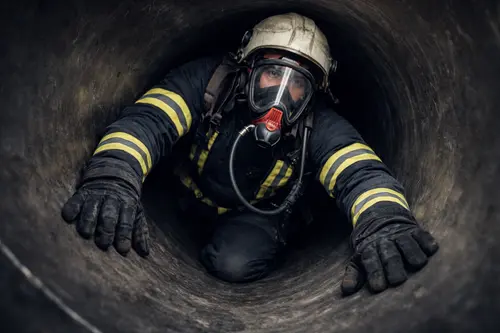
This course is designed for new and experienced personnel required to work in confined spaces and wear breathing apparatus in the resources and infrastructure industries at an operational levelMany roles require confined space and breathing apparatus training, including safety, injury prevention and maintenance personnel, engineers, risk managers, mine managers, cable installers and transport personnel. The breathing apparatus training covers working in a confined space, with hazardous gases/vapours, or in an oxygen deficient atmosphere and who may work alone or as part of a team as an operator required to wear breathing apparatus in their work role.   

Participants will learn to distinguish what constitutes a confined space; key terminology; as well as understand the regulations and legislative requirements governing entering and working in and around confined spaces. Participants will identify hazards and emergencies as well as implement appropriate control measures; conduct risk assessments and apply for a confined space entry permit. This course set also covers the skills and knowledge required to conduct pre-donning checks and tests on breathing apparatus, operate and maintain breathing apparatus and equipment in an irrespirable atmosphere, and conclude operations as defined by the Australian Standard AS/NZS 1715:2009 Selection, use and maintenance of respiratory protective equipment. 

Students will demonstrate how to enter, exit and work safely in a confined space according to an issued permit for two scenarios. Participants will also inspect and select appropriate personal protective gear; operate various confined space safety equipment including atmospheric testing/monitoring devices; and conduct routine servicing of all equipment and gear. Concluding operations will include correctly closing down, removing and cleaning the breathing apparatus and reporting faults and/or damage to breathing apparatus.

Units Delivered

The following units will be included in your certificate:

MSMWHS216 - Operate breathing apparatus
RIIWHS202E - Enter and work in confined spaces

Course Delivery

This course can be delivered/assessed in the workplace or at facility organised by the training provider.

Course Durations

Course durations can vary for multiple reasons, so the durations below are the minimum possible amount.

Refresher Face to Face contact time of at least 5 Hours
Face-to-Face Face to Face contact time of at least 9 Hours

An individual undertaking this course with Allens Training Pty Ltd will need to demonstrate the following to be eligible for entry:

  • An official form of photo identification (e.g., driver’s licence, passport, or student ID). 
  • Participants are required to be clean shaven to attend this course, in accordance with AS/NZS 1715:2009 and AS/NZS ISO 16975.3 and AS/NZS ISO 17420-1. Facial hair within the sealing area can compromise the effectiveness of the respirator, impacting its ability to provide proper protection. 
  • Protective footwear/safety shoes and comfortable/practical clothing must be provided by the student and worn during the practical sessions and assessment. 
  • Psychological* and physical capability to be able to meet the demands of the practical demonstrations for this course, such as the undertaking of the requirements to safely enter, work in and exit a confined space wearing appropriate PPE. This may involve climbing up, down, through or under structures or confined spaces, being suspended, wearing harnesses and other relevant PPE, dragging and lifting in confined and restricted environments in dark, low light or smoke-filled areas.

To successfully complete this course, students will need to demonstrate the following language, literacy, numeracy and digital (LLND) skills during training and assessment:

  • Learning: Follow clear instructions, ask questions if I’m unsure, and take steps to keep myself and others safe while working.
  • Reading: Read and understand safety signs, work procedures, and equipment instructions before starting a task.
  • Writing: Fill in simple forms, checklists, or reports with clear and accurate information.
  • Oral communication: Use different methods (like speaking, radios, or signals) to share clear information and check understanding with others.
  • Numeracy: Use numbers to check air pressure, measure time, and follow steps in the right order.
  • Digital Literacy: Able to use a mobile phone or basic device to read messages, follow online instructions, complete online forms or access learning resources


*Safe Work Australia notes “Working in a confined space may impose additional physiological demands over and above those encountered in a normal working environment. Consideration should be given to a worker’s:

  • physical ability;
  • ability to work in a restrictive space (for example claustrophobia)
  • ability to wear the PPE required to do the work (for example respirators).

Confined spaces can also give rise to psychosocial hazards such as:

  • high job demands (e.g. high levels of physical, mental or emotional effort are needed to do the job)
  • low job control (e.g. workers unable to limit where they are required to work in a restrictive space)
  • poor physical environments (e.g. performing hazardous work, doing demanding work while wearing uncomfortable PPE, conditions that affect concentration or are unpleasant), and
  • remote or isolated work (e.g. significant delays to entering or exiting the space, or difficulty getting help in an emergency).”

SWA Code of Practice Confined Spaces Nov 2024 


Individuals undertaking this course will be expected to complete both written and practical assessment tasks.

The units have the following recommended renewal periods:
Unit Period
MSMWHS216 - Operate breathing apparatus Not applicable
RIIWHS202E - Enter and work in confined spaces Not applicable

Please note that enrolment to this course is made with Allens Training Pty Ltd RTO 90909. Please refer to the student handbook located on the RTO website allenstraining.com.au (https://allenstraining.com.au/students/student-handbook) for all details relating to rights and responsibilities including complaints and appeals.

Performance tasks:

  • Horizontal and vertical entry into confined space
  • Use atmospheric monitoring devices prior to entering the confined space  
  • Demonstrate pre-donning checks, tests procedures and fault reporting
  • Demonstrate concluding operation techniques
  • Label the components of breathing apparatus
  • Demonstrate consistency in performance over time in a range of actual or simulated environments

Documentation:

  • Completion of two site-based Risk Assessment forms and Confined space entry permits
  • Completion of an Equipment Fault log  

Theory assessment  A written assessment consisting of multiple-choice and short answer questions. The student must complete all assessment questions.

Students are required to complete a self evaluation against the following core skills as part of the enrolment process. This will allow your trainer to understand any additional support that may be required during the course delivery and assessment.
Learning I can follow clear instructions, ask questions if I’m unsure, and take steps to keep myself and others safe while working.
Reading I can read and understand safety signs, work procedures, and equipment instructions before starting a task.
Writing I can fill in simple forms, checklists, or reports with clear and accurate information.
Oral Communication I can use different methods (like speaking, radios, or signals) to share clear information and check understanding with others.
Numeracy I can use numbers to check air pressure, measure time, and follow steps in the right order.
This course is delivered and assessed on behalf of Allens Training Pty Ltd RTO 90909